
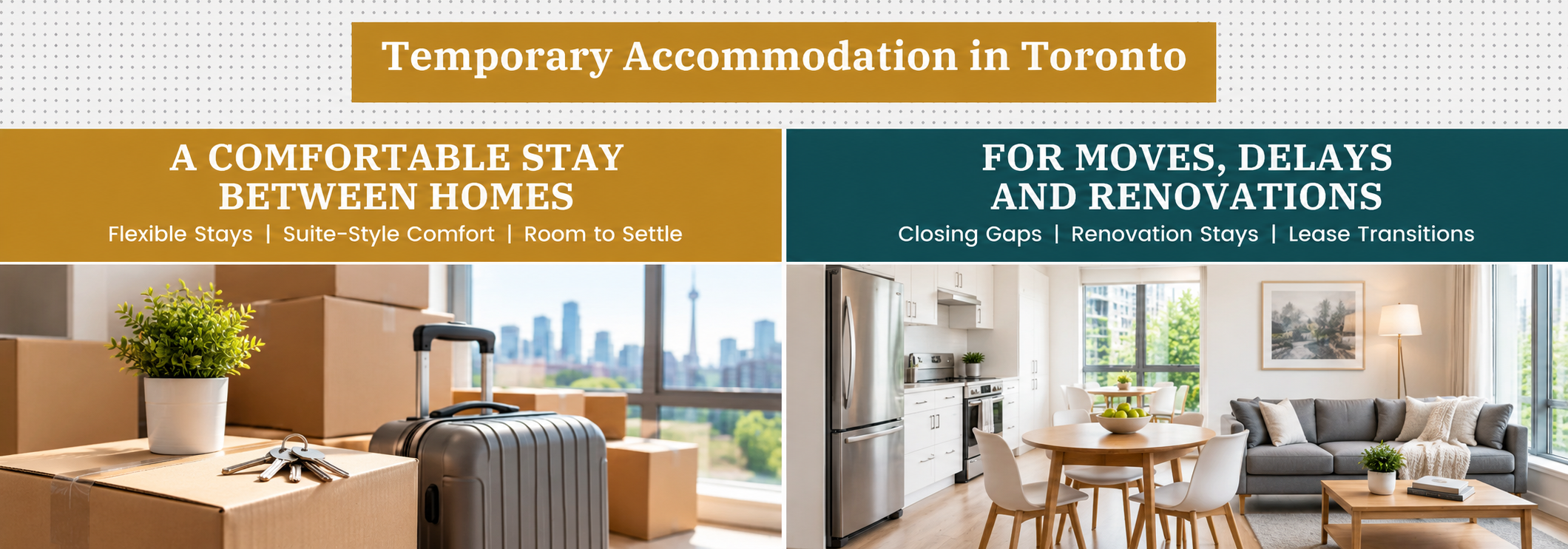
Your sale has closed, the keys to your new place aren’t ready, and the move-in date has already shifted once. A gap between homes is harder to plan than a trip, because you often don’t know when it will end. Finding a place to stay between homes in Toronto comes down to matching the accommodation to how firm that end date is. This guide covers your options, how to plan around a moving date, what the stay really costs, and what to ask before you book.
Why do people need a place to stay between homes in Toronto?
Most gaps between homes in Toronto come from four situations: a sale closes before a purchase, the closing on a new-build home or condo is delayed, a renovation makes the home unliveable, or one lease ends before the next begins. Each one can leave you needing somewhere to live for weeks or months, often without a fixed end date.
If your sale closes first, you have to move out by the sale’s closing date. Where to live between selling and buying a house then depends on how far apart the two closing dates are. If you want to rent the home back from the buyer after closing (a rent-back), ask your real estate lawyer whether that’s an option.
If you bought a new freehold home in Ontario, meaning a house rather than a condo unit, and the builder misses the firm closing date, Tarion’s delayed closing warranty usually requires the builder to compensate you. Tarion runs Ontario’s new home warranty program. The amounts are covered further down, in the section on planning around a changing move-in date.
A renovation can make a home unliveable while the kitchen or the only bathroom is out of use. Temporary housing during a renovation in Toronto lasts as long as the contractor’s schedule, so ask for a realistic end date in writing.
When one lease ends before the next begins, even a few days without keys means finding somewhere to sleep and somewhere to store your furniture.
Hotel suite, furnished rental, or short-term lease: which fits a gap between homes?

The right choice depends on how firm your end date is. A short-term lease suits a long gap with a fixed end, because it trades flexibility for a set term. A suite-style hotel suits a gap that might shrink or grow, because your booking follows the hotel’s cancellation terms rather than a fixed term.
The three options differ most on commitment, on flexibility when dates change, and on whether Ontario’s Residential Tenancies Act (RTA) applies. The RTA is the law that covers most residential tenancies.
| Feature | Hotel suite | Furnished rental | Short-term lease |
|---|---|---|---|
| Minimum stay | Not limited by Toronto’s 28-night rule | Often 28 nights or more | Set by the lease |
| Commitment | The nights you book | The dates agreed with the host | The full lease term |
| Deposit | Set by each hotel | Set by each host | No more than one month’s rent, used for the last month |
| What’s furnished | Fully furnished, with a kitchen and laundry in some suites | Furnished, with contents that vary by listing | Varies by unit |
| Flexibility if dates change | Set by the hotel’s cancellation terms | Set by the host’s cancellation terms | Limited to what the lease allows |
| Tenant law | The RTA does not apply to a temporary stay | The RTA may apply, depending on the arrangement; ask before you sign | The RTA applies |
Under Toronto’s short-term rental rules, a short-term rental is all or part of a home rented for less than 28 consecutive days. Short-term rentals are allowed only in the host’s principal residence, which is why many furnished listings require 28 nights or more. Hotels and motels are excluded from the city’s short-term rental definition. The RTA does not apply to a unit used on a seasonal or temporary basis, according to the Landlord and Tenant Board’s guide for new tenants.
An extended-stay hotel in Toronto gives you a furnished suite without a lease term, which makes it a practical form of temporary housing in Toronto when dates are uncertain. Our suites at Skye Hotel & Residences each have a full kitchen with a full-size fridge, stove, oven, and dishwasher, plus an in-suite washer and dryer, a living area with a sofa bed, and a work desk. Those features close most of the gap between a hotel room and an apartment. You can book a suite for a week, or stay for months while you wait on a closing date. For a closer look at the two options, see our full comparison of hotels and furnished apartments.
How do you plan when your move-in date might change?
The safest plan is a place you can cancel or adjust without losing a month’s rent, booked with a buffer of a few days on each side of your expected date. That buffer protects you if the closing date moves a little in either direction.
Get your closing date in writing and use it as the reference point for every booking. If the builder or seller gives you a range, plan around the later end of the estimate.
A lease or a 28-night furnished rental locks you into a set term. If your closing comes early, you pay for nights you don’t use. If it comes late, you may have to find another place at short notice. Booking early on terms you can change secures the space and limits what a moved date costs you.
What does Tarion cover if your new home is delayed?
For a new freehold home, a builder that misses the firm closing date must set a delayed closing date and pay you compensation of up to $7,500, unless the delay was mutually agreed or caused by an unavoidable event. The compensation includes living expenses for meals and accommodation, paid at a fixed $150 a day with no receipts required. Extra moving and storage costs caused by the delay are also covered, with receipts. A builder using tentative closing dates can extend twice, by up to 120 days each time, without paying compensation. These amounts apply to freehold homes. If you’re facing a new condo occupancy delay, your coverage falls under a separate delayed occupancy warranty, so check its terms with Tarion. In either case, read the Addendum to your purchase agreement and ask your lawyer about your own dates.
Can a family live comfortably in a hotel suite for a few weeks?

Yes, if the suite has a full kitchen, its own laundry, and separate sleeping space. Those three features decide whether a few weeks feels like home or like a long hotel stay.
With a full kitchen, you can cook family meals and pack school lunches the way you do at home. A microwave and a bar fridge won’t carry a family through weeks of meals, so when you book a hotel with a kitchen in Toronto, confirm that it has a full-size fridge, stove, and oven. In-suite laundry saves trips to a laundromat, which matters more the longer you stay. Separate sleeping space lets children go to bed while adults are still up.
Our two-bedroom suites come in three layouts: queen, deluxe queen, and deluxe king and queen. Every suite has a sofa bed, a smart TV with streaming services, and heating and cooling you control yourself. Accessible suites are available, and we can book a separate suite for visiting family, subject to availability.
Where do your mail, car, and belongings go while you wait?
Before moving day, sort out four things: the essentials you’ll keep with you for two to four weeks, storage for everything else, parking for your car, and your mail and daily commute. Each one is easier to arrange before the move than from a temporary address.
Keep your identity and closing documents, seasonal clothes, kitchen basics, and children’s school items with you. Storage is a separate cost from your accommodation. If your new freehold home is delayed, Tarion’s warranty covers the extra storage costs caused by the delay, as long as you keep receipts.
Before you move, update your mailing address with your bank, employer, and schools, and set up mail forwarding so important letters don’t go to your old home. Try the route to work and school from your temporary address before the first day.
At our hotel, every suite has its own mailbox and parking is on site. The Westmore stop on Line 6 Finch West is close by, and the line connects to Line 1 at Finch West Station. We’re also a short drive from Toronto Pearson International Airport.
What does temporary accommodation cost beyond the nightly rate?
The real cost is the nightly or monthly rate plus deposits, taxes, cancellation fees, and the cost of moving twice. Two options with similar rates can end up far apart once you add those costs, and in Toronto the type of stay also decides which taxes you pay.
Monthly hotel rates in Toronto and monthly rent are only the starting point. Under a lease, a landlord can collect a rent deposit of no more than one month’s rent, according to the same Landlord and Tenant Board guide. That deposit must be used for your last month’s rent, not for damages.
Since August 1, 2026, Toronto’s Municipal Accommodation Tax (MAT) has been 6% on the room portion of hotel stays of four hours or more, and Harmonized Sales Tax (HST) is also charged on the MAT portion. The Canada Revenue Agency (CRA) treats residential rentals and hotel stays differently. Under the CRA’s rules on residential rentals, renting a home as a place to live for a continuous month or more is exempt from GST/HST. A hotel, by comparison, must charge GST/HST on a continuous stay when the rate is over $20 a day.
Cancellation terms decide what a changed date costs you, and a one-night fee costs far less than an unused month’s rent. Moving twice also means paying movers twice, and storage fees run for the whole gap.
We offer flexible rates for extended stays. Contact us with your dates for a quote, and see our booking and cancellation policies on our FAQ page.
What should you ask before booking temporary accommodation?
Start with the questions that protect you if your dates change, then ask the ones that decide whether the place works for daily life. Get the answers on cancellation, minimum stay, and deposits in writing, so there are no surprises once you’ve moved in.
- Cancellation. Can I cancel, and by when?
- Minimum stay. Is there a minimum number of nights?
- Deposit. What deposit or credit card hold is taken?
- Taxes. Are taxes included in the quote?
- Kitchen. Is there a full kitchen with a full-size fridge, stove, and oven?
- Laundry. Is there a washer and dryer inside the unit?
- Sleeping space. How many people does the unit sleep, and is there a separate bedroom?
- Parking. Is parking included?
- Mail. Where does my mail go during the stay?
- Accessibility. Is an accessible unit available for my dates?
For more checks, see our checklist for furnished accommodation.
A temporary-stay checklist for moving between homes
A stay between homes runs in three stages: before the move, during the stay, and before moving in. Most of the work happens in the first stage, because you settle the dates, the booking, and the storage before you leave.
Before the move
- Get your closing or move-in date in writing.
- Book accommodation on terms you can change.
- Arrange storage for everything beyond the essentials.
- Update your mailing address and set up mail forwarding.
During the stay
- Keep receipts for moving and storage if your new home was delayed.
- Make sure your builder or seller has your current contact details.
Before moving in
- Confirm the final date with your builder or seller.
- Give your accommodation notice under its terms.
Waiting on a closing date? Ask Skye about availability for your dates. Call us at (416) 746-4691 or send us your dates through our inquiry form.
Planning a temporary stay in Toronto?
Ask us about suite availability and extended-stay rates while you wait for your next home.
Contact Skye Hotel & ResidencesCall (416) 746-4691